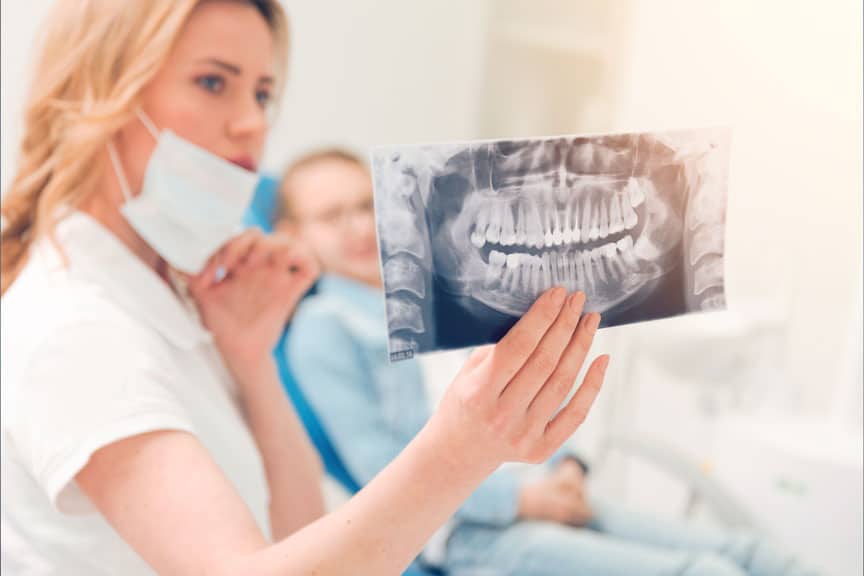

When a tooth has been damaged by decay, a crack, or a broken old filling, the dentist’s job is to restore it in a way that brings back function while removing as little healthy tooth structure as possible. Two options that often come up for back teeth are dental inlays and dental crowns. They’re both durable, long-lasting restorations, but they’re designed for different situations and involve different amounts of tooth preparation.
Understanding how they differ can help you have a more informed conversation at your next appointment at Linden Market Dental Centre in Winnipeg.
What an Inlay Is
An inlay is a custom-made restoration that fits within the cusps of a back tooth, filling in a damaged or decayed area without covering the entire tooth surface. It’s made outside the mouth, typically from porcelain or composite resin, from an impression or digital scan of the prepared tooth. Once fabricated, it’s bonded precisely into position.
Think of an inlay as a puzzle piece that fills a specific area of damage. It doesn’t extend over the cusps or wrap around the sides of the tooth. It sits within the natural boundaries of the tooth’s chewing surface.
An onlay is a related restoration that covers one or more of the tooth’s cusps in addition to the inlay area. It’s used when damage extends beyond what an inlay can address but falls short of requiring full crown coverage. You’ll sometimes see inlays and onlays grouped, as Linden Market Dental Centre does on the inlays and onlays page, because they work on the same principle.
What a Crown Is
A dental crown covers the entire visible portion of the tooth above the gumline. To place a crown, the dentist reduces the outer surface of the tooth on all sides and on top, removing a layer of enamel to create a uniformly shaped core that the crown fits over like a cap.
Crowns are made from porcelain, ceramic, metal, or a combination, and once cemented they fully enclose the prepared tooth. They’re strong, durable, and well-suited to teeth that have lost a significant amount of natural structure.
The Key Difference: How Much Tooth Is Removed
This is where the practical distinction between the two restorations lies. Preparing a tooth for an inlay requires removing only the damaged or decayed portion and shaping the remaining healthy structure to accept the restoration. The bulk of the healthy enamel and dentine that surrounds the damage stays intact.
Preparing a tooth for a crown requires reducing the entire outer surface. Even portions of the tooth that are perfectly healthy need to be trimmed down to create the shape the crown fits over. For a tooth with limited damage, this means removing healthy structure that didn’t need to be removed.
This matters for a straightforward reason: natural tooth structure is the strongest material in the restoration equation. The more of it that remains intact, the better the long-term prognosis for the tooth. Enamel removed during preparation doesn’t grow back, and a tooth that has been heavily prepared for a crown is permanently altered, even if the crown is eventually replaced or fails.
When an Inlay Is the More Appropriate Choice
Inlays work well for teeth where the damage or decay is contained within the cusps and hasn’t compromised the structural integrity of the tooth overall. If the chewing surface has significant decay or an old filling that needs replacing, and the cusps themselves are intact and healthy, an inlay can restore the damaged area without touching the healthy surrounding structure.
They’re also a good option when a direct filling would be too large to be reliably placed and expected to hold long-term. For medium-to-large cavities on back teeth, particularly in areas of high chewing load, the precision fit and durability of a lab-fabricated inlay often outperform a directly placed composite filling.
When a Crown Is the More Appropriate Choice
A crown becomes necessary when the damage to a tooth is extensive enough that an inlay or onlay can’t provide adequate structural support. This typically applies to:
- Teeth that have lost a significant portion of their structure to decay or fracture
- Teeth that have been weakened by large, old amalgam or composite fillings that have cracked the remaining tooth walls
- Teeth that have undergone root canal treatment, which removes the nerve and blood supply and leaves the tooth more brittle
- Teeth with cracks that extend into the cusp structure
In these situations, the tooth needs the full enclosure that a crown provides. Placing an inlay on a tooth with insufficient remaining structure risks fracture.
How the Decision Gets Made at Linden Market Dental Centre
Dr. Winchar evaluates the amount of remaining healthy tooth structure, the location and extent of damage, and the functional demands on that tooth before recommending an inlay, onlay, or crown. Where an inlay is clinically suitable, it’s worth considering specifically because it preserves more of the tooth’s natural structure. Where the damage is too extensive, a crown protects what remains.
This is exactly the kind of nuanced clinical judgment that a thorough dental exam in Winnipeg is designed to produce. Both restorations are available at Linden Market Dental Centre, and the recommendation will be based on your specific tooth’s condition.
About Linden Market Dental Centre
Linden Market Dental Centre is located at 877 Waverley St, Unit 7, Winnipeg, MB. Dr. Morgan Winchar provides general, cosmetic, and restorative dental care for families and individuals across Winnipeg. The clinic accepts the Canadian Dental Care Plan (CDCP) and welcomes new patients.
Book an Appointment at Linden Market Dental Centre in Winnipeg
If you have a tooth that needs attention and want to understand your restoration options, the team at Linden Market Dental Centre can walk you through what makes sense for your situation.
Call (204) 487-2226 to book your appointment.
- Schedule a restorative dentistry consultation at Linden Market Dental Centre in Winnipeg
- Call us to ask about inlays, onlays, or dental crowns for a damaged tooth
- Book an appointment with Dr. Winchar at our Waverley St dental clinic
- Contact Linden Market Dental Centre about CDCP coverage for restorative work
- Request your new patient exam at our Winnipeg dental office today